
 ror.org/01ej9dk98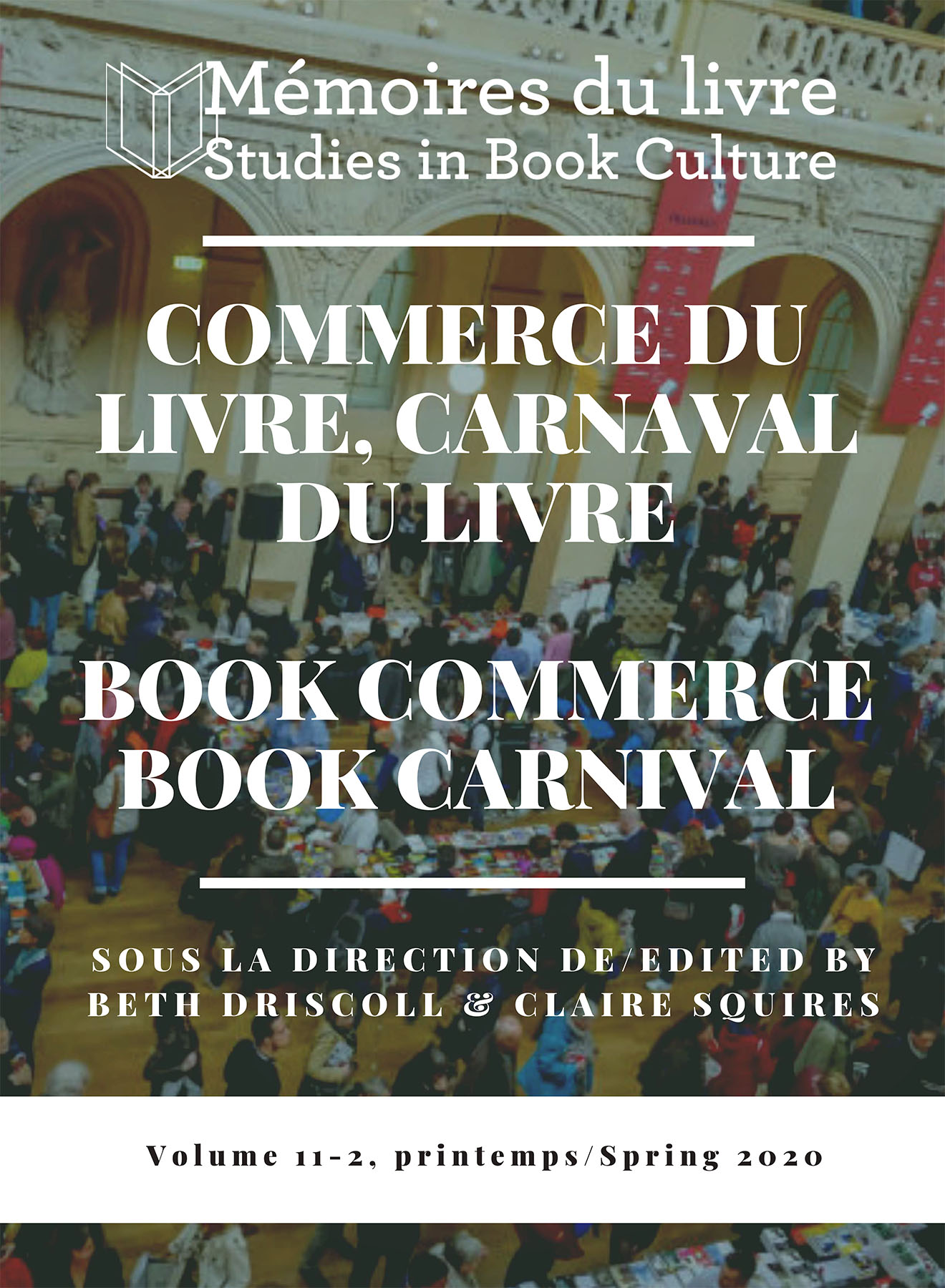

Until early this year, an individual interested in, or professionally involved with, the twenty‑first‑century world of books could travel the globe incessantly, attending book fairs, writers’ festivals, and readers’ conventions. Our roving reader, writer, publisher, or other agent in the communications circuit of the book is a literary Carmen Sandiego, darting from country to country, crossing genres, finding herself at a festival on a ferry, a canal boat, or a train. Occasionally Carmen’s passage, and thus the whole communications circuit itself, might be inhibited by the consciousness of her carbon footprint, impeded by immigration policy and visa restrictions, or cancelled due to pandemic disease. Book fairs and festivals are hubs of literary, bookish activity. The annual global calendar includes, among thousands of others, Byron Bay Writers’ Festival in Australia, Iceland Noir, and Ubud Readers and Writers Festival in Indonesia, as well as the peripatetic—and travel-themed—Étonnants Voyageurs, which takes place in St Malo (France), Bamako (Mali), and Port-au-Prince (Haiti). Book fairs take place in locations including Bologna (Italy), where the focus is specifically on children’s books and illustration, Guadalajara (Mexico), and Sharjah (UAE). These fairs and festivals are a subset of a broader category of periodic global cultural and commercial festivals and events, from live music festivals to performance art happenings, and from automotive trade fairs to United Nations climate change conferences. Bookish events have very local manifestations, too, attracting participants from geographically close communities, or they can be based partially or solely on digital delivery, as with the Glasgow Women’s Library in Scotland, whose Open the Door festival is in alternate years digital and physical. Book-based cultural and commercial events are the subject of this special issue, BOOK COMMERCE BOOK CARNIVAL. From the foundation of the Frankfurt Book Fair in 1454 to the growth of the festival format in the postwar period to the proliferation of digital and live events in the twenty-first century, book fairs and festivals have shaped book cultures and publishing industries. The history of these events has by now been well established. Broadly, we would typify the existing scholarly frameworks as deriving from cultural sociology and creative economy studies. Such scholarship, as we outlined more substantially in our previous Mémoires du Livre/Studies in Book Culture article, “Serious Fun: Gaming the Book Festival,” has often taken a Bourdieusian approach, sometimes furthered via an attentiveness to Pascale Casanova’s arguments about the uneven global distribution of prestige in the “world republic of letters.” Book festivals and fairs have been analyzed as worlds, as games, as tournaments, as fields, as events, as microcosms, as situations, as institutions, as networks. Our own initial interest in book fairs and festivals gave rise to an ongoing research collaboration concerning the dynamics of book cultures. In “Serious Fun,” we put forward the approach of game‑inspired thinking as a strategy to create “a space between individual case studies and abstract theories to offer a mid-level perspective” on book festivals, one that is “deliberately playful and creative, an arts-informed complement to methodological empiricism” as well as super-structural conceptualizations. This article was foundational in our development of the conceptual school Ullapoolism, a post-data, activist, autoethnographic epistemology for contemporary book culture studies. We further developed this approach in our fieldwork and publications based on the Frankfurt Book Fair. As we argue in our forthcoming book The Frankfurt Book Fair and Bestseller Business, book fairs and festivals lend themselves to being read through theories of the carnivalesque. We pursue Brian Moeran’s idea that publishing trade fairs, and particularly their after-hours alcohol-fuelled social gatherings, have a carnivalesque aspect. Moeran sees a historical relationship between contemporary book fairs and medieval …
Appendices
Bibliography
- Arcordia, Charles, and Michelle Whitford. “Festival Attendance and the Development of Social Capital.” Journal of Convention & Event Tourism 8, no. 2 (2006): 1–18. https://doi.org/10.1300/J452v08n02_01.
- Bakhtin, M. M. Problems of Dostoevsky’s Poetics. Translated by Caryl Emerson. Minneapolis: University of Minnesota Press, 1984.
- Bartie, Angela, and Eleanor Bell. The International Writers’ Conference Revisited: Edinburgh, 1962. Glasgow: Cargo Publishing, 2012.
- “BookBound2020 on Twitter: ‘@pollyrowena Within Our Team We Had Thought of ‘housebound’ in Terms of People Being at Home, Together with the ‘Bound’ of Book Binding; as Well as People Being Bound Together/United around the World through Books. Your Message Was a Wake-up Call. We Apologise Unreservedly.’ / Twitter.” Accessed April 1, 2020. https://twitter.com/BookBound2020/status/1245004958996606976.
- Bourdieu, Pierre. The Field of Cultural Production: Essays on Art and Literature. Cambridge: Polity Press, 1993.
- Cain, Sian. “UK Refuses Visas for a Dozen Edinburgh Book Festival Authors | Books | The Guardian.” Accessed February 21, 2020. https://www.theguardian.com/books/2018/aug/08/visas-refused-for-a-dozen-authors-invited-to-book-festival.
- Casanova, Pascale. The World Republic of Letters. Cambridge, MA: Harvard University Press, 2004.
- Driscoll, Beth. The New Literary Middlebrow: Tastemakers and Reading in the Twenty-First Century. Basingstoke: Palgrave Macmillan, 2014.
- Driscoll, Beth, and Claire Squires. “Megativity and Miniaturization at the Frankfurt Book Fair.” Post45, April 8, 2020. http://post45.org/2020/04/megativity-and-miniaturization-at-the-frankfurt-book-fair/.
- Driscoll, Beth, and Claire Squires. The Frankfurt Book Fair and Bestseller Business. Cambridge: Cambridge University Press, forthcoming 2020.
- Driscoll, Beth, and Claire Squires. “Serious Fun: Gaming the Book Festival.” Memoires Du Livre / Studies in Book Culture 9, no. 2 (2018).
- Driscoll, Beth, and Claire Squires. “The Epistemology of Ullapoolism: Making Mischief from within Contemporary Book Cultures.” Angelaki 25, no. 5 (Forthcoming 2020).
- Finkelstein, David, and Claire Squires. “Book Events, Book Environments.” In Cambridge History of the Book in Britain Volume 7: The Twentieth Century and Beyond, edited by Andrew Nash, Claire Squires, and Ian Willison, 668–78. Cambridge: Cambridge University Press, 2019.
- Grindon, Gavin. “Carnival Against Capital: A Comparison of Bakhtin, Vaneigem and Bey.” Anarchist Studies 12, no. 2 (2004): 15.
- Marsden, Stevie, and Claire Squires. “The First Rule of Judging Club…: Inside the Saltire Society Literary Awards.” Journal of Cultural Analysis and Social Change 4, no. 2 (2019): 10. https://doi.org/10.20897/jcasc/6354.
- Merriman, Ben. “The Editorial Meeting at a Little Magazine: An Ethnography of Group Judgment.” Journal of Contemporary Ethnography 46, no. 4 (2017): 440–63. https://doi.org/10.1177/0891241615615918.
- Moeran, Brian. “Trade Fairs, Markets and Fields: Framing Imagined as Real Communities.” Messen, Märkte Und Felder: Die Rahmung von Imaginierten Als Reale Gemeinschaften von Marktteilnehmern. 36, no. 3 (2011): 79–98.
- Moeran, Brian, and Jesper Strandgaard Pedersen, eds. Negotiating Values in the Creative Industries. Cambridge: Cambridge University Press, 2011.
- Murray, Simone. The Adaptation Industry: The Cultural Economy of Contemporary Literary Adaptation. London and New York: Routledge, 2012.
- “Polly Atkin Is Social Distancing on Twitter: ‘Think about How You Use and Appropriate Language, and the Inference It Has. For Example, a Group of Disabled Writers Setting up a Festival Called #HouseBound2020 Is Entirely Different to a Group of Normally Healthy Ones Doing It. #TheChronicLife #ChronicityInTheTimeOfCorona’ / Twitter.” Accessed April 1, 2020. https://twitter.com/pollyrowena/status/1244925194243842049.
- Radway, Janice A. A Feeling for Books: The Book-of-the-Month Club, Literary Taste, and Middle-Class Desire. Chapel Hill: University of North Carolina Press, 1997.
- Radway, Janice A. Reading the Romance: Women, Patriarchy, and Popular Literature. Chapel Hill: University of North Carolina Press, 1984.
- Sapiro, Gisele. “The Metamorphosis of Modes of Consecration in the Literary Field: Academies, Literary Prizes, Festivals.” Poetics 59 (2016): 5–19. https://doi.org/10.1016/j.poetic.2016.01.003.
- Squiscoll, Blaire. The Frankfurt Kabuff. Glasgow and Melbourne: Kabuff Books, 2019.
- Vaneigem, Raoul. The Revolution Of Everyday Life. Translated by Donald Nicholson-Smith. Expanded edition. London: Rebel Press, 2001.
- Vincent, Josee. “Les Salons Du Livre A Montreal, Ou Quand 'Livre' Rime Avec...” In Autour De La Lecture: Mediations et Communautes Litteraires, edited by Josee Vincent and Nathalie Watteyne, 207–28. Montreal, QC : Editions Nota Bene, 2002.
- Weber, Millicent. Literary Festivals and Contemporary Book Culture. New York: Palgrave Macmillan, 2018.
 10.7202/1046988ar