
Résumés
Abstract
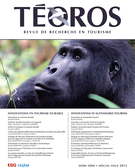
This paper illustrates an innovative approach to enhance rural livelihoods through community tourism in Uganda. Following pro-poor tourism principles of local participation and linking with existing systems, Gorilla Friends Tented Camp opened in Ruhija village, where mountain gorillas were recently habituated for gorilla tracking tours. In a village that had no previous tourist accommodations and few opportunities for villagers to earn income, a percentage of profits from Gorilla Friends Tented Camp are returned to support other livelihood enhancement initiatives in the village. While much of our previous research has focused on identifying and developing local capacity to participate meaningfully in Uganda’s tourism industry, attention must also be paid to tourists’ experiences at the site to ensure continued viability. Findings based on interviews with tourists to Ruhija illustrate the need for national partnership networks to support local community tourism. Additionally, understanding how tourists came to and experienced the community will assist the local people with sustainability of their operations and activities, and inform continued innovation in community tourism development in Ruhija.
Keywords:
- community tourism,
- partnership,
- Uganda,
- poverty,
- wildlife
Parties annexes
Bibliography
- ADAMS, William M and Mark INFIELD (2003) “Who is on the Gorilla’s Payroll? Claims on Tourism Revenue from a Ugandan National Park”. World Development, vol. 31, n° 1, pp. 177-190.10.1016/S0305-750X(02)00149-3 Google Scholar Rechercher cette référence bibliographique sur Google Scholar
- APPLEGATE, James E. and Kathleen E. CLARK (1987) “Satisfaction Levels of Birdwatchers: An Observation on the Consumptive – Nonconsumptive Continuum”. Leisure Sciences, vol. 9, p. 129-134.10.1080/01490408709512152 Google Scholar Rechercher cette référence bibliographique sur Google Scholar
- ASHLEY, Caroline; Dilys ROE and Harold GOODWIN (2001) Pro-poor Tourism Strategies: Making Tourism Work for the Poor. A Review of Experience. London: Overseas Development Institute. 54 p.Google Scholar Rechercher cette référence bibliographique sur Google Scholar
- BOO, Elizabeth (1990) Ecotourism: The Potentials and Pitfalls (vol. 1). World Wildlife Fund, Washington, DC. Google Scholar Rechercher cette référence bibliographique sur Google Scholar
- BROWN, Desmond Omotayo (2000) “Political Risk and Other Barriers to Tourism Promotion in Africa: Perceptions of US Based Travel Intermediaries”. Journal of Vacation Marketing, vol. 6, n° 3, pp. 197-210.10.1177/135676670000600301 Google Scholar Rechercher cette référence bibliographique sur Google Scholar
- CAMPBELL, J. Michael; K. J. MACKAY and Christine DRANZOA (2011a) “Enhancing Rural Livelihoods Through Tourism Education and Strategic Partnerships: A Uganda Case Study”. Tourism Analysis, vol. 16, n° 1, pp. 5-17.10.3727/108354211X12988225899921 Google Scholar Rechercher cette référence bibliographique sur Google Scholar
- CAMPBELL, J. Michael; Richard DRAMA; Kelly J. MACKAY and John Bosco AMUNO (2011b) Sustainable Tourism and Mountain Gorilla Conservation in Uganda. The Wildlife Society Conference, Waikoloa, Hawaii. November 5-10, 2011.Google Scholar Rechercher cette référence bibliographique sur Google Scholar
- CHOK, Stephanie; Jim MACBETH and Carol WARREN (2007) “Tourism as a Tool for Poverty Alleviation: A Critical Analysis of Pro-Poor Tourism and Implications for Sustainability”. In Pro-poor tourism: Who benefits? Perspectives on tourism and poverty reduction, edited by C. Michael HALL, pp. 34-55. Clevedon : Channel View Publications.10.21832/9781845410766-003 Google Scholar Rechercher cette référence bibliographique sur Google Scholar
- FODNESS, Dale and Brian MURRAY (1999) “A Model of Tourist Information Search Behavior”. Journal of Travel Research, vol. 37, n° 3, pp. 220-230.10.1177/004728759903700302 Google Scholar Rechercher cette référence bibliographique sur Google Scholar
- Government of Uganda (2000) Poverty Reduction Strategy Paper. Uganda’s Poverty Eradication Action Plan : Summary and Main Objectives. Ministry of Finance, Planning and Economic Development, Kampala, Uganda. http://www.imf.org/external/np/prsp/2000/uga/01/. Retrieved 01.06.2012.Google Scholar Rechercher cette référence bibliographique sur Google Scholar
- Government of Uganda (2004) Sustainability Initiatives for the Uganda Wildlife Authority (Draft). Uganda Wildlife Authority, Kampala, Uganda. http://www.thegef.org/gef/sites/thegef.org/files/repository/Uganda_-_Protected_Areas_Mgmt.pdf. Retrieved on 01.03.2012. Google Scholar Rechercher cette référence bibliographique sur Google Scholar
- JASEN, Patricia (1995) Wild Things, Nature, Culture, and Tourism in Ontario 1790-1914. University of Toronto Press, Toronto. 194 p. 10.3138/9781442683495 Google Scholar Rechercher cette référence bibliographique sur Google Scholar
- JUN, Soo Hyun; Christine A. VOGT and Kelly J. MACKAY (2010) “Online Information Search Strategies: A Focus on Flights and Accommodations”. Journal of Travel and Tourism Marketing, vol. 27, n° 6, pp. 579-595.10.1080/10548408.2010.507151 Google Scholar Rechercher cette référence bibliographique sur Google Scholar
- KAH, Junghye Angela; Christine VOGT and Kelly MACKAY (2011) “Place-Based Information Technology Use on Vacations”. Tourism Geographies, vol. 13, n° 2, pp. 209-233.10.1080/14616688.2010.529934 Google Scholar Rechercher cette référence bibliographique sur Google Scholar
- LAUDATI, Ann (2010) “Ecotourism: the Modern Predator? Implications of Gorilla Tourism on Local Livelihoods in Bwindi Impenetrable National Park, Uganda”. Environment and Planning D: Society and Space, vol. 28, n° 4, pp. 726-743.10.1068/d15708 Google Scholar Rechercher cette référence bibliographique sur Google Scholar
- LEPP, Andrew (2008) “Tourism and Dependency: An Analysis of Bigodi Village, Uganda”. Tourism Management, vol. 29, n° 6, pp. 1206-1214.10.1016/j.tourman.2008.03.004 Google Scholar Rechercher cette référence bibliographique sur Google Scholar
- LUBBE, Berendien (2005) “A New Revenue Model for Travel Intermediaries in South Africa: The Negotiated Approach”. Journal of Retailing and Consumer Services, vol. 12, n° 6, pp. 385-396.10.1016/j.jretconser.2005.03.002 Google Scholar Rechercher cette référence bibliographique sur Google Scholar
- PATTON, Michael (2002) Qualitative Research & Evaluation Methods 3rd Edition. Sage Publications, Thousand Oaks. 598 p.Google Scholar Rechercher cette référence bibliographique sur Google Scholar
- REYNOLDS, Paul C. and Dick BRAITHWAITE (2001) “Towards a Conceptual Framework for Wildlife Tourism”. Tourism Management, vol. 22, n° 1, pp. 31-42.10.1016/S0261-5177(00)00018-2 Google Scholar Rechercher cette référence bibliographique sur Google Scholar
- RGFRC – Ruhija Gorilla Friends Resort Campsite (not dated) “Ruhija Gorilla Friends Resort Campsite – Local Community Livelihood Enhancement though a Sustainable Tourism Project”, brochure from RGFRC, Kabale, Uganda http://www.itfc.org/Gorila%20Friends%20Campsite%20Brochure.pdf, retrieved on March 01, 2012.Google Scholar Rechercher cette référence bibliographique sur Google Scholar
- TRAUER, Birgit (2006) “Conceptualizing Special Interest Tourism – Frameworks for Analysis. Tourism Management, vol. 27, n° 2, pp. 183-200.10.1016/j.tourman.2004.10.004 Google Scholar Rechercher cette référence bibliographique sur Google Scholar
- UNDP – United Nations Development Programme (2006) UNDP Human Development Report Country Fact Sheets (Uganda).Google Scholar Rechercher cette référence bibliographique sur Google Scholar
- VOGT, Christine A. & Daniel R. FESENMAIER (1998) “Expanding the Functional Information Search Model”. Annals of Tourism Research, vol. 25, n° 3, pp. 551-578.10.1016/S0160-7383(98)00010-3 Google Scholar Rechercher cette référence bibliographique sur Google Scholar
- WEAVER, David B. and Laura J. LAWTON (2002) “Overnight Ecotourist Market Segmentation in the Gold Coast Hinterland of Australia”. Journal of Travel Research, vol. 40, n° 3, pp. 270-280.10.1177/0047287502040003005 Google Scholar Rechercher cette référence bibliographique sur Google Scholar
- ZHAO, Weibing and J. R. Brent RITCHIE (2007) “Tourism and Poverty Alleviation: An Integrative Research Framework”. In Pro-poor tourism: Who benefits? Perspectives on tourism and poverty reduction, edited by C. Michael HALL, pp. 9-33. Clevedon: Channel View Publications.10.21832/9781845410766-002 Google Scholar Rechercher cette référence bibliographique sur Google Scholar